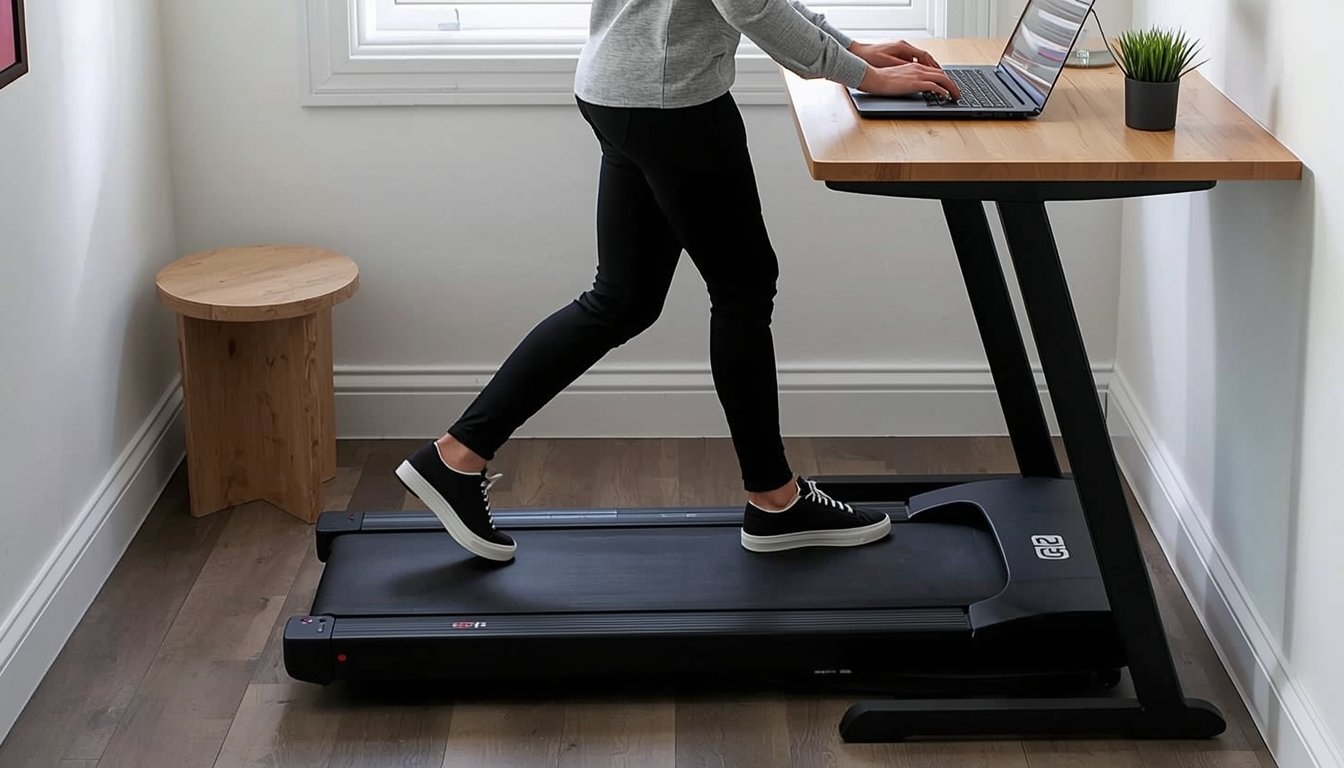
For desk work, a walking pad usually works best at a slow pace rather than a workout pace. For many people, that means about 1.0 to 2.0 mph, with beginners often starting closer to 0.7 to 1.0 mph until walking while working feels natural.
How It Works
A walking pad for desk work is meant to support steady, low-intensity movement while you type, read, or attend meetings. The goal is not speed. The goal is to keep moving without making work tasks too difficult.
As speed increases, upper-body movement, sway, and foot impact usually increase as well. That can make typing, mousing, reading, and concentration harder, which is why slower speeds are generally recommended for work use.
What It Can Do
- Support light movement while you work
- Help break up long periods of sitting
- Allow short or moderate walking sessions during the day
- Work well for reading, email, and simple desk tasks at slower speeds
- Give you flexibility to adjust pace based on the task you are doing
Limitations / What It Cannot Do
A walking pad for desk work is not designed to be used at the same speed you would use for exercise walking outdoors or on a regular treadmill. Faster speeds usually reduce typing accuracy and make detailed work harder.
It also cannot give one perfect speed that suits everyone. Comfort depends on experience, stride, balance, desk height, footwear, and the kind of task you are doing. A speed that feels fine for reading may feel too fast for spreadsheet work or writing.
Another limitation is that the machine’s maximum speed is not the same as its best desk-working speed. Some walking pads can go much faster, but that does not mean those higher speeds are practical while working.
When It Works Best
Walking pads work best for desk work when the pace is slow enough that you can still type and focus with minimal disruption. Research-based active-workstation guidance has used 0.7 to 1.0 mph during the first week of acclimation, then 1.0 to 2.0 mph once users are more comfortable.
They also work best when you match speed to the task. Slower speeds usually suit typing, meetings, and concentration better than faster ones. If your typing accuracy drops or you feel unstable, the speed is probably too high for desk work.
Common Misconceptions
One common misconception is that faster is automatically better. For desk work, that is usually not true. The point is to stay active while still being able to work.
Another misconception is that the recommended speed is whatever the machine can reach. In reality, desk-work speed is usually much lower than the machine’s top speed.
A third misconception is that everyone should use the same setting. In practice, people often need to adjust within a slower range based on experience and the type of work they are doing.
Final Answer Summary
For desk work, a walking pad should usually be set to a slow pace, often around 1.0 to 2.0 mph. Many people do better starting closer to 0.7 to 1.0 mph and increasing only if they can still work comfortably and safely.