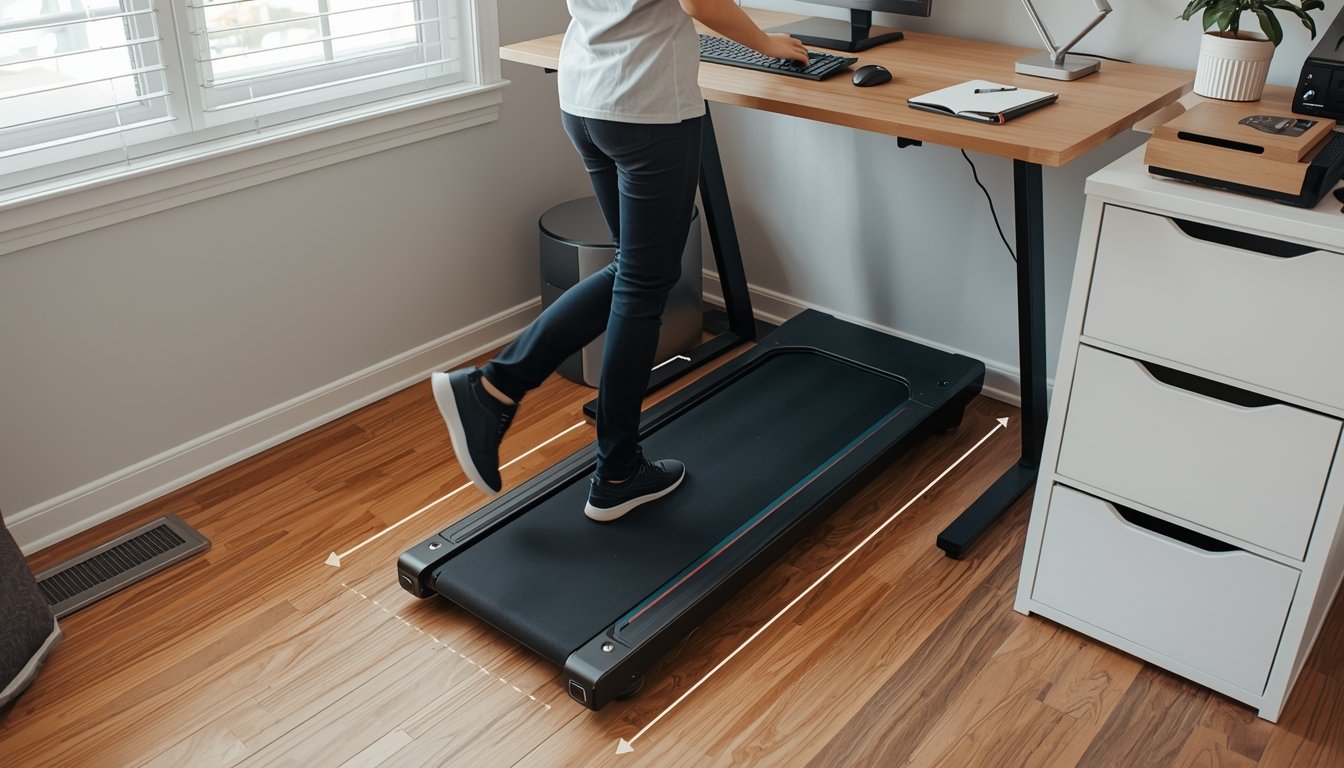
Most walking pads need less floor space than a full treadmill, but you need room for both the machine itself and safe clearance around it. Many compact models are around 56 inches long and 21 to 22 inches wide when unfolded, while some fold down to about 32.5 by 21.5 inches for storage. The exact space you need depends on the model, your stride, and whether you also need room for a desk or safe step-on and step-off access.
How It Works
A walking pad has two different space requirements: operating space and storage space. Operating space means the unfolded footprint plus the open area needed to get on, off, and move around it safely. Storage space means the folded dimensions if the model folds.
For example, the WalkingPad P1 is listed at 56.37 x 21.5 x 5 inches when unfolded and 32.5 x 21.5 x 5 inches when folded. That gives a useful reference point for how much floor space a compact walking pad may take up, but not every model is the same size.
What It Can Do
- Fit into smaller rooms more easily than a full treadmill
- Slide under some desks, beds, or sofas if the height and folded dimensions allow it
- Work in home offices where a larger machine would be impractical
- Save storage space when the model folds or has a slim frame
- Provide a walking area that is often enough for low-speed indoor walking
Limitations / What It Cannot Do
A walking pad cannot be measured by footprint alone. You also need enough clearance to step on and off safely and to avoid placing the machine where nearby objects block movement.
Another limitation is that a compact size does not guarantee it will fit every room or every desk setup. The walking area itself can also be smaller than a standard treadmill. For example, the WalkingPad P1 lists a walking area of 47.24 x 16.5 inches, which is practical for walking but more limited than a larger treadmill deck.
There is also no single universal safety-clearance rule published specifically for all walking pads. Standard treadmill manuals commonly recommend clear space around the machine, including around 19.5 inches on each side and 79 inches behind the machine, but those figures come from larger treadmill manuals and may be more conservative than the needs of some compact under-desk models.
When It Works Best
A walking pad works best when the room has enough space for the machine to sit fully flat on a level surface, with enough open space to mount and dismount without obstruction. It is usually easier to use in a home office or spare room where furniture placement can be adjusted around it.
It also works best when you measure both the machine and the available floor area before buying. For compact spaces, folded dimensions matter just as much as unfolded dimensions if you plan to store the unit after each use.
Common Misconceptions
One common misconception is that if a walking pad is called compact, it will automatically fit any small room. Actual dimensions still vary by model, and compact does not mean tiny.
Another misconception is that storage size is the only number that matters. In practice, the unfolded size and the safe access space around the machine are at least as important.
A third misconception is that walking pads need the same amount of space as full treadmills. They usually need less floor area, but they still need enough room for safe use and should not be squeezed into a tight gap with no clearance.
Final Answer Summary
You usually need enough space for a walking pad’s full footprint plus extra room to get on and off safely. Many compact models are roughly 56 by 21 inches in use and around 32.5 by 21.5 inches when folded, but the safest approach is to check the exact dimensions of the model and measure your available floor and storage space before buying.